
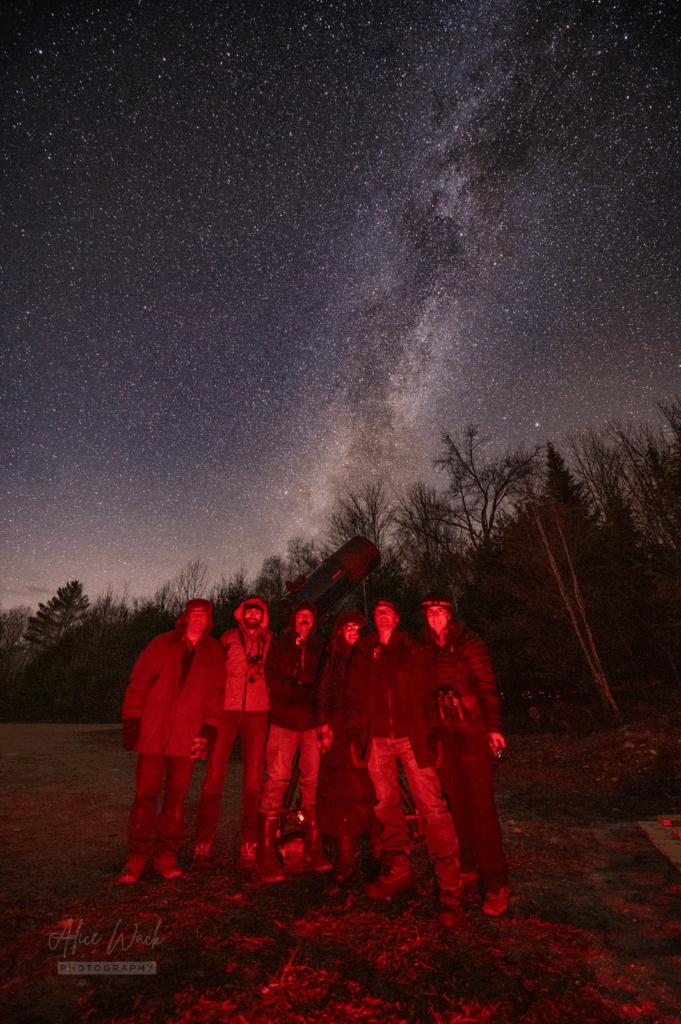
Monthly astronomy programs invite the public to explore the night sky alongside scientists, volunteers, and fellow stargazers. Feature Photo by Alice Wack.
On a clear night in Western Maine, the universe is now within view — with the aid of a 14-inch telescope, that is.
The Maine Mineral & Gem Museum has opened a new window to the cosmos with its brand-new MMGM Hoffelder Observatory, and it’s inviting the public to take a look beyond Earth. With the launch of the Western Maine Star Chasers Astronomy Club, MMGM is also developing a new community-centered astronomy program built around shared curiosity, dark skies, and the science that connects stars, planets, and meteorites.
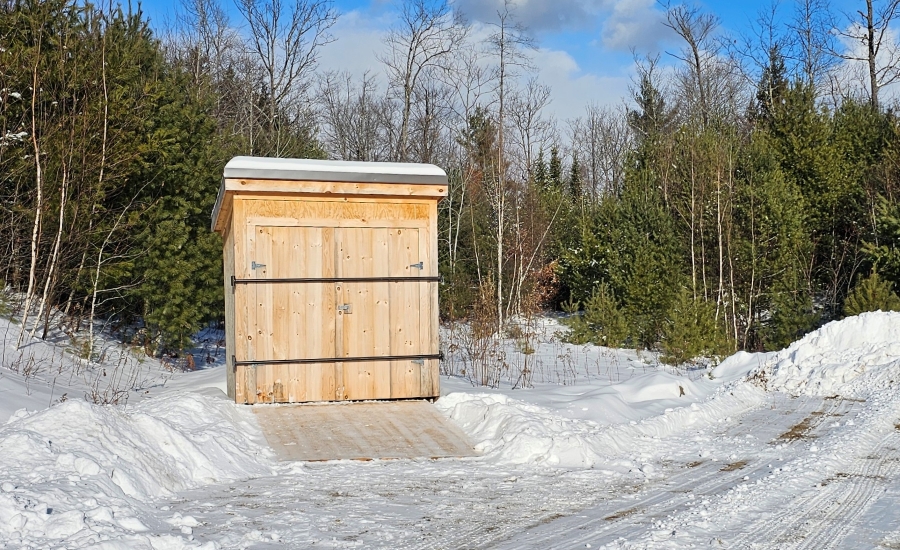
Completed in November, the Hoffelder Observatory marks an exciting expansion of MMGM’s educational programming beyond Earth — inviting visitors to look outward and explore the broader cosmos that shapes our planet, its minerals, and its meteorites.
At the heart of the Observatory is a 14-inch telescope, made available to the public during sanctioned programs led by MMGM staff and trained volunteers. From distant galaxies to nearby planets — and occasionally the fiery streaks of meteor showers — the telescope offers a powerful new way to connect science, storytelling, and shared experience under dark Western Maine skies.
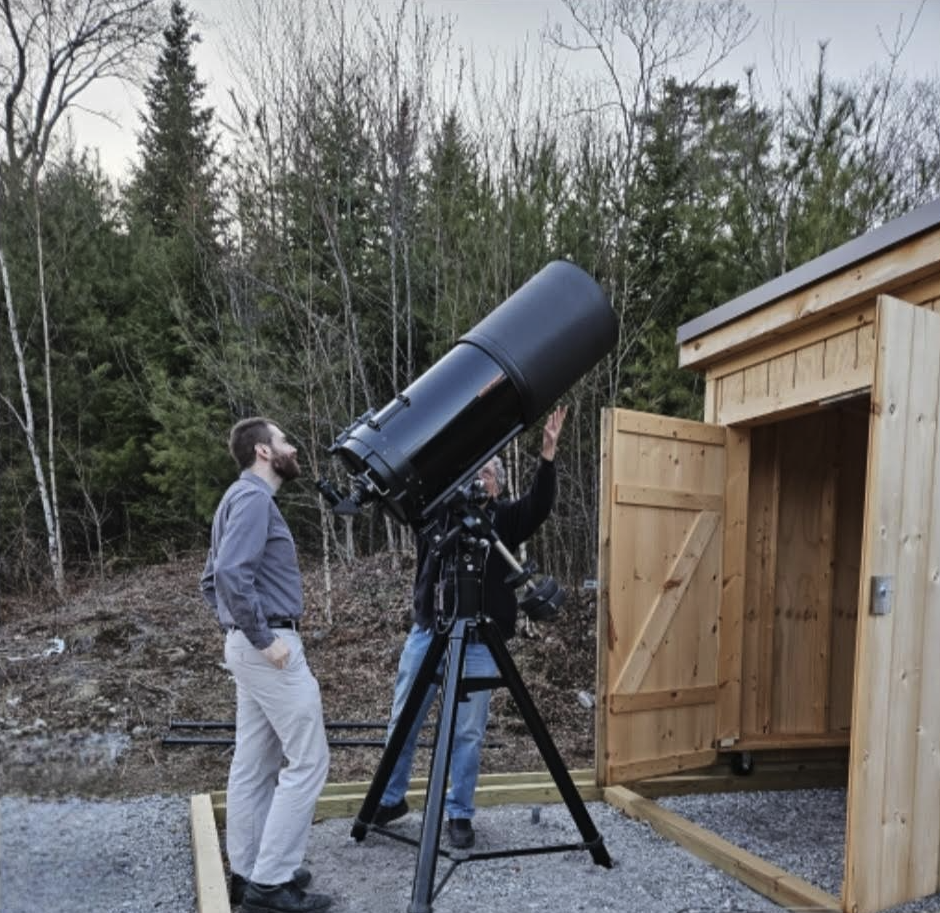
Left Photo: MMGM Meteorite Project Director Patrick Leverone (left) and volunteer Tom Hoffelder test out the 14-inch telescope prior to the completion of the Hoffelder Observatory.
Right Photo: The Hoffelder Observatory, completed in November, now houses a 14-inch telescope and hosts events.
A Telescope with a Long Orbit (and a Lot of Heart)
The telescope itself has traveled a long way to reach Bethel. Tom Hoffelder, the Observatory’s namesake and a longtime MMGM volunteer, purchased the 14-inch telescope with his wife while living in Tulsa, Oklahoma, in 1998.
“It’s above average size for amateurs,” Hoffelder said. “Fourteen inches is pretty big, and you can see a lot with it.”
The aeronautical engineer-turned-amateur astronomer has spent decades sharing his passion for the stars and galaxies beyond with the public. Now, he’ll regularly be reaching other amateurs to stargaze and share his vast knowledge through the Western Maine Star Chasers Astronomy Club at MMGM, which he leads with the museum’s Meteorite Project Director, Patrick Leverone.
All observatory programming will be open and accessible to the public. The 14-inch telescope is housed permanently at MMGM’s Hoffelder Observatory at the Long Mt. Trail parking area, 1268 Vernon St., Albany Township.
Occasionally, the group will host gatherings at The Gem Theater parking lot, where Hoffelder will use his slightly less powerful 8-inch telescope to show off the moon, solar system and more.
Everyone is welcome. There are no memberships, no dues, and the programming is totally free. The philosophy is simple: show up when you can, look up together, and enjoy the universe.
The Star Chasers will meet approximately once a month, typically on a Friday or Saturday evening, to remain flexible around weather conditions. If skies don’t cooperate, events will pivot to indoor lectures and talks at MMGM in Bethel.
Those interested in participating or receiving event notifications are encouraged to email MMGM Meteorite Project Director Patrick Leverone directly at pleverone@mainemineralmuseum.org to join a dedicated astronomy events email list. This allows the Museum to communicate last-minute schedule changes, weather updates, and observing targets.
A Natural Extension of MMGM’s Mission
According to Leverone, the Observatory and Star Chasers Club are a natural extension of MMGM’s focus on meteorites and planetary science.
“What we talk about in the meteorite gallery — where elements come from, how planets form, the death and birth of stars — you can actually see pieces of that story in the night sky,” Leverone explains. “You can look at Mars and the Moon, which are the sources of some meteorites. You can observe star-forming regions and remnants of dead stars. It helps contextualize our place in the universe.”
Hoffelder shares that same belief in seeing as a form of understanding. While astrophotography has become increasingly popular, he remains devoted to visual observing.
“I’m strictly visual,” he said. “I want to look in the eyepiece and say, I saw that object… You’re actually seeing the actual object.”
And when visitors do see it, the experience can land with real force.
“We’re looking at a galaxy that’s 100 million light-years away,” Hoffelder said. “The light left that galaxy 100 million years ago… and you can see it.”
He often links that cosmic timescale to something tangible — handing stargazers a 200-million-year dinosaur foot while showing them galaxies 200 million light-years away.
“I’ll have them hold that, and say, look in there, the light you’re seeing left that galaxy when the dinosaur stepped into mud,” Hoffelder said.
From Meteor Showers to Galaxies
Programming will vary throughout the year based on celestial conditions. Events may include:
- Meteor shower viewing, such as December’s Geminid Meteor Shower — the first official Star Chasers event since the opening in November.
- Planetary observing nights, featuring the Moon, Jupiter, Saturn, and even distant dwarf planets.
- Deep-sky observing, including galaxies like Andromeda, located more than 2.5 million light-years away.
- Indoor lectures and presentations during weathered-out weekends
While meteor showers are visible to the naked eye, Leverone notes that observing them together adds a powerful communal and educational layer.
“You’re sharing the sky. Someone sees a meteor and calls it out. Questions start flowing — what are we seeing, how fast is it moving, what’s it made of?” he says. “Even with just a few people, it becomes a conversation that deepens the experience.”
Open to All Ages, Curiosity Required
The Western Maine Star Chasers Astronomy Club is open to all ages. Families, adults, amateur astronomers, and curious first-timers are all welcome. Participants are encouraged to dress warmly, bring binoculars or telescopes if they have them, and arrive with headlights off to preserve night vision for everyone.
Future possibilities include daytime solar observing, homeschool and school-adjacent programs, and collaborations with regional dark-sky and land-trust partners.
Looking Up, Together
With the Hoffelder Observatory now open and the Western Maine Star Chasers Astronomy Club underway, MMGM invites the community to experience the wonder of the night sky—not alone, but together.
For Hoffelder, the joy is watching people make that first real connection, whether through a telescope lens or in the galleries at MMGM.
“I’ve never had so much fun in my life,” he said of volunteering and sharing the experience. One moment stands out: “Handing the Moon and Mars rocks to kids… at one event, there was this five- or six-year-old girl, she never said a word. She held one, she held the other, and she just looked at me and, without a word, held her hand up for a fistbump.”
As Leverone puts it, “Seeing the universe firsthand helps people connect the dots between science, Earth, and their own place in it. That kind of perspective matters.”