
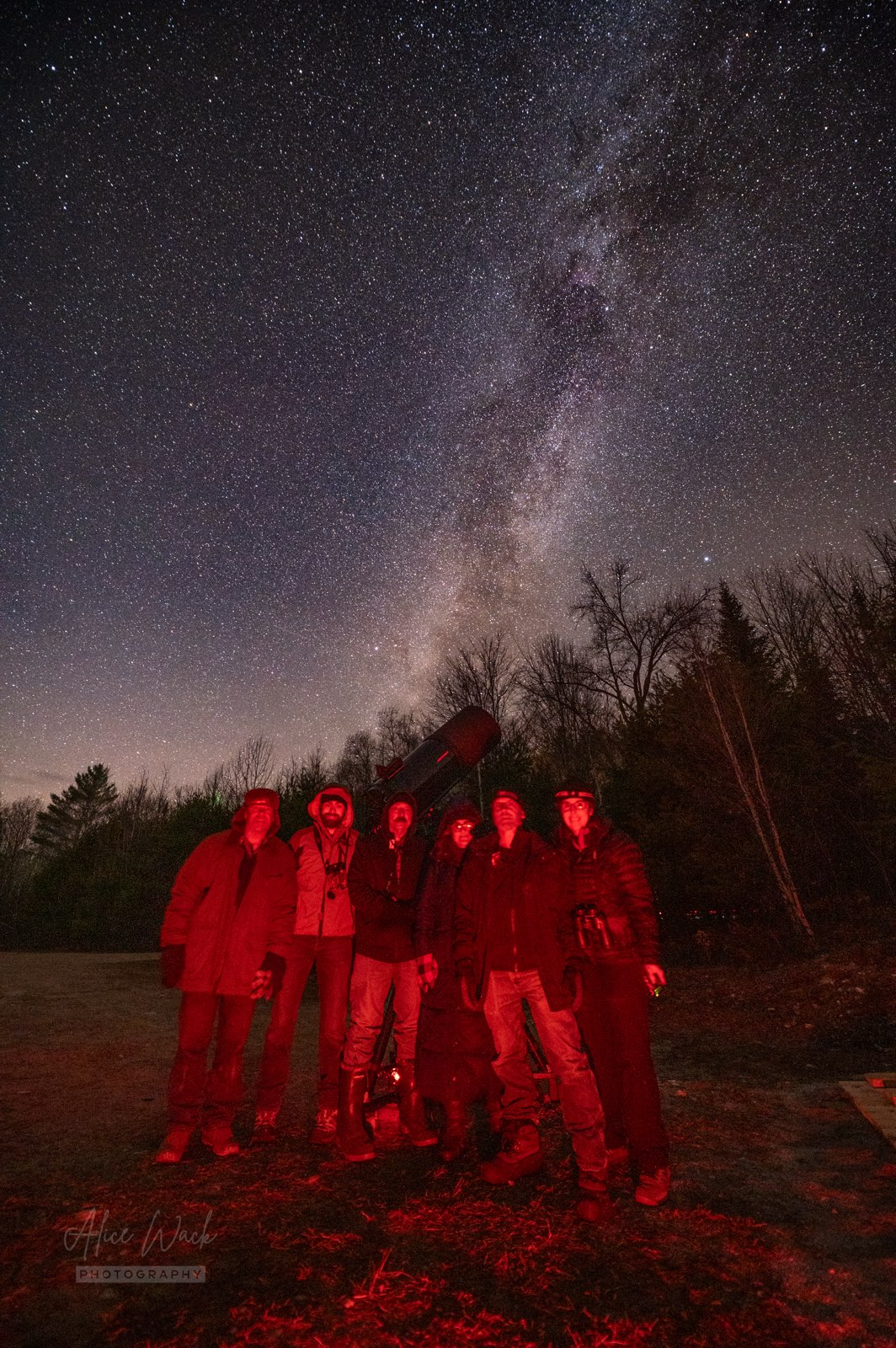
April Astronomy Nights: Western Maine Star Chasers
**Please note, Astronomy nights and events with the Western Maine Star Chasers Astronomy Club are weather/cloud dependent. As such, they are subject to frequent change, rescheduling, and/or cancellation. Please check in here, on Facebook, or with MMGM on event days for up-to-date information.
Date: April 4 (CANCELED) Upcoming: 10, or 11
Time: 8:00-9:30 PM
(And/Or)
Reschedule Date: April 17 or 18
Time: 8:30-10:00 PM
Where: Hoffelder Observatory, Parking area for Long Mountain Trail, 1268 Vernon St., Albany TWP, ME
Event Details:
The following objects should be visible through the 14″ telescope in our regular deep sky astronomy session. See the attached object list for more details from Tom.
1. Jupiter: The largest planet of our Solar System, appearing brighter than any star in the night sky. Some Galilean moons will be visible.
2. Orion Nebula (M42): Visually the best night sky object, this is a star-forming region made to glow by ultraviolet light from its most massive “offspring.”
3. Crab Nebula (M1): The glowing remnant of a supernova witnessed almost 1,000 years ago.
4. M46 & NGC 2438: An open cluster of young stars behind a planetary nebula, the remnant of an unrelated star that became a red giant before its death.
5. M35 & NGC 2158: Two open star clusters that appear next to each other, but are far apart.
6. Clown Face Nebula (NGC 2392): Another planetary nebula- a glowing gas shell expelled in the death of a sun-like star.
7. M81 & M82: Two spiral galaxies in close proximity, one of which is a “starburst galaxy” with a very high star-forming rate.
8. The Leo Triplet (M65, M66, & NGC 3628): A trio of spiral galaxies that show signs of a recent “near-miss” interaction: enhanced star formation in one and gas and dust trailing out from another.
9. M3: One of the largest and brightest globular clusters in our Milky Way; an estimated 500,000 stars form this old, dense cluster.
Other Info:
BYOO (Bring Your Own Optics): Binoculars and telescopes are welcome.
When you arrive at the Observatory, please avoid aiming lights (including headlights) to the left. Red lights can aid your footing without interrupting our night vision.
Dress for the weather, but hot chocolate will be available.
About the Western Maine Star Chasers Astronomy Club
Join the Western Maine Star Chasers Astronomy Club to explore the night skies through a 14-inch telescope at MMGM’s Hoffelder Observatory. The cosmos will dictate the topic each month, and events occur, weather permitting.
Join the email list to stay in the loop on the latest events, happenings, and weather updates affecting programming! To join, email MMGM Meteorite Project Director Patrick Leverone at pleverone@mainemineralmuseum.org.
Check out more MMGM events here!
Organizer