MMGM is Closed. We'll reopen Sun at 11 AM

The World’s Most Species-Rich Pegmatite

The Emmons Pegmatite, Greenwood, Maine

DIG DEEPER: GEOLOGY AND MINERALOGY OF THE EMMONS PEGMATITE

These sections provide expanded scientific context for visitors interested in the regional geology and complex mineralogy of the Emmons Pegmatite. This material expands on concepts introduced in the exhibit.

REGIONAL GEOLOGY & THE OXFORD COUNTY PEGMATITE FIELD

Regional Geology

The New England Appalachians formed during a series of Paleozoic orogenic events between the breakup of the supercontinent Rodinia in the Neoproterozoic to the final assembly of the supercontinent Pangea in the Permian.

During these collisional events, the eastern margin of Laurentia was modified by the addition of land masses that were deformed, metamorphosed, intruded by granitic plutons, and uplifted during a succession of Paleozoic orogenies, including the Taconic (Ordovician, ~450 Ma), Acadian (Late Silurian–Early Devonian, ~400 Ma), Neoacadian (Late Devonian–Early Mississippian, ~350 Ma), Late Pennsylvanian (~320 Ma), and Alleghenian (Pennsylvanian–Permian, ~300 Ma) (Robinson et al. 1998; Eusden et al. 2017; Bradley et al. 2016).

By the end of the Alleghenian Orogeny, the Appalachian Mountain belt stretched thousands of kilometers across the interior of the now-assembled Pangea supercontinent. Supercontinent breakup began soon afterward, with Triassic to Early Jurassic intraplate magmatism and rifting leading to the opening of the Central Atlantic Ocean from the Early Jurassic to the present.

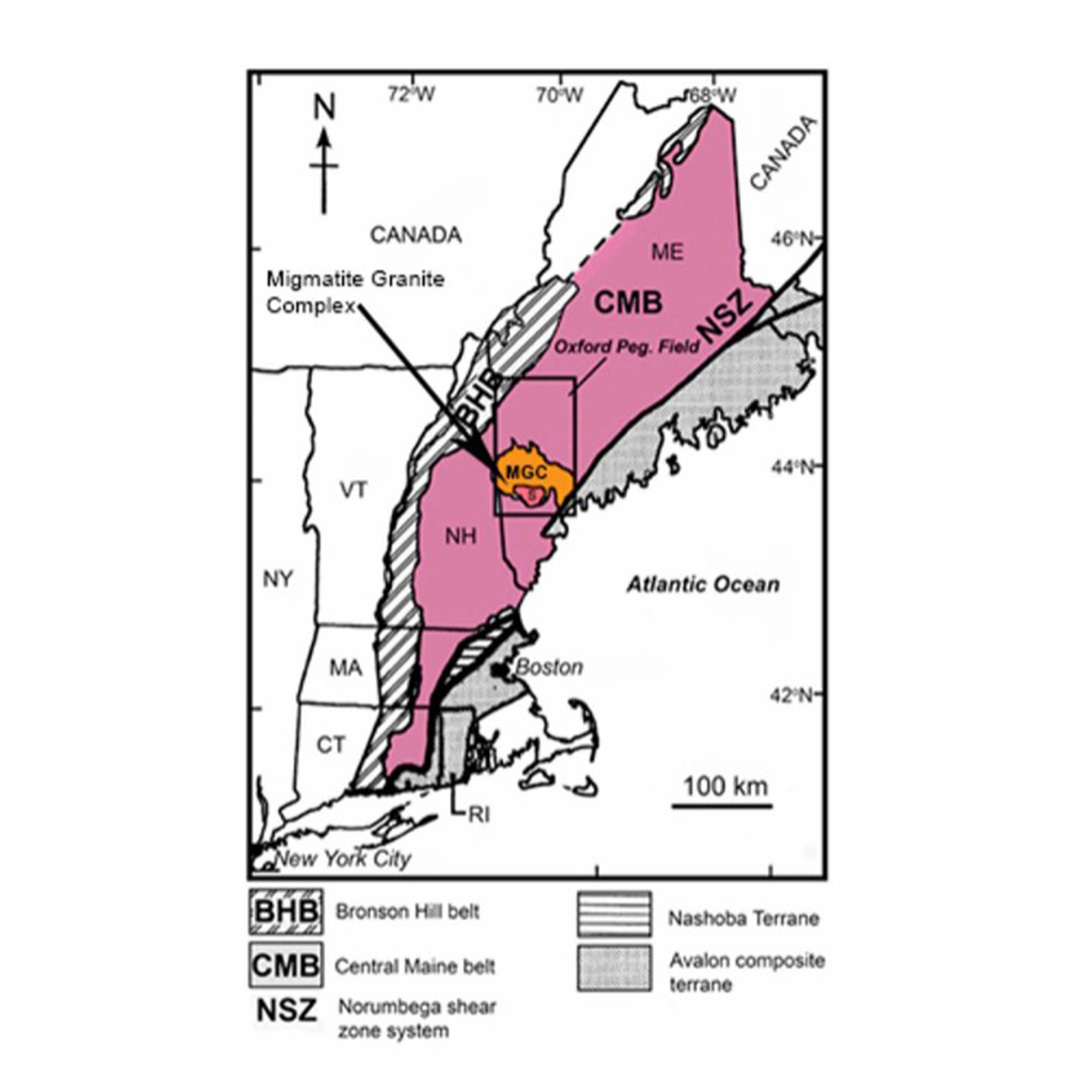
The Oxford County pegmatites of western Maine are situated in the Central Maine Belt (Fig. 1), a belt of metasedimentary rocks that were deposited in the Late Ordovician, Silurian, and earliest Devonian periods.

FIGURE 1– More than 100 pegmatites have been mapped in the Oxford County Pegmatite Field (OCPF), outlined with a box. Most of them intrude into the orange area called the Migmatite-Granite Complex (MGC). This area was formerly mapped as the Sebago Batholith but is now represented by the smaller area labeled "S" and is called the Sebago pluton. Modified from Solar & Brown (2001). Pegmatite Locations are from Rand (1957), Wise & Brown (2010).

These rocks originated as marine sediments deposited in a deep-water basin, the Central Maine Basin, immediately before and during the Acadian orogeny (Bradley et al. 2000). Deformation and metamorphism of the lithified sediments took place during the Acadian, Neoacadian, and Alleghenian orogenies (Eusden et al. 2017).

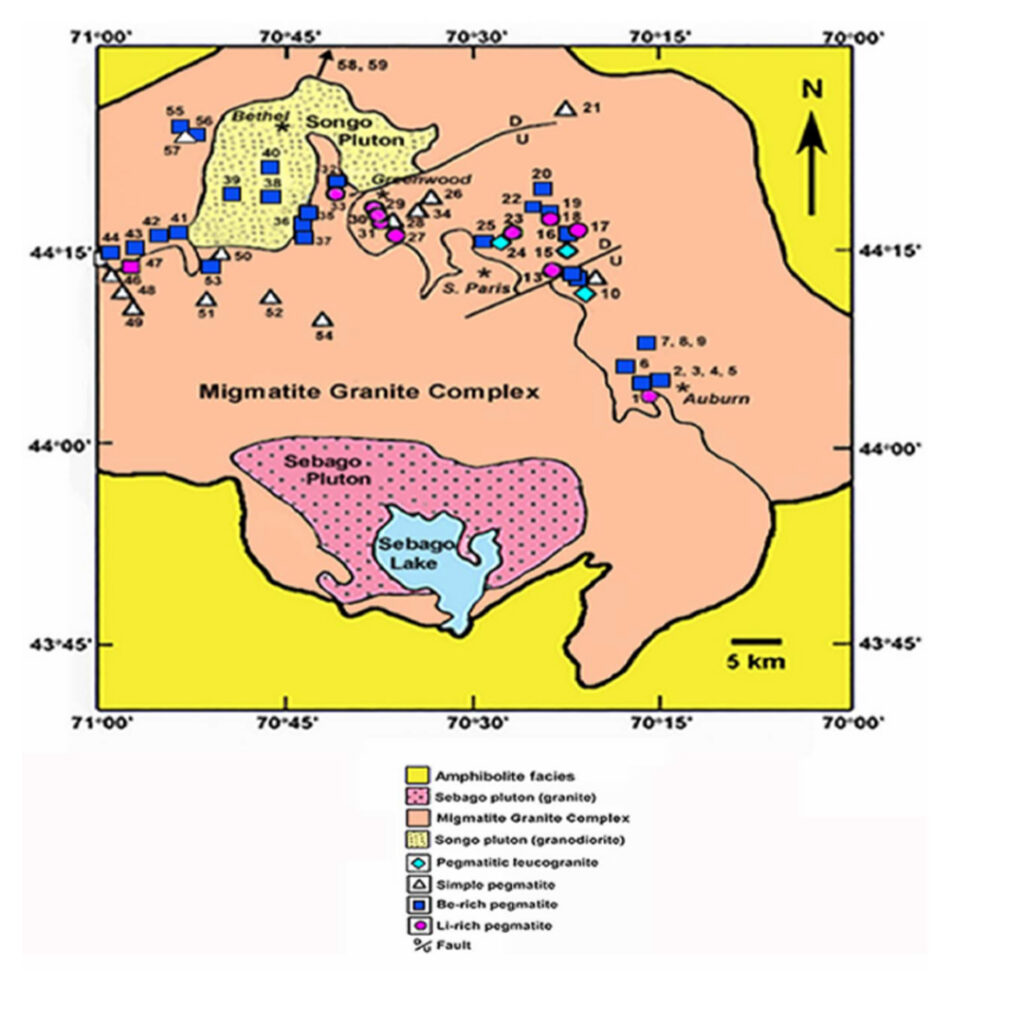
Within the Central Maine Belt, the Migmatite-Granite Complex (MGC, formerly the Sebago Migmatite Domain) formed from metamorphism and migmatization of rocks at ~376 Ma (Solar & Tomascak 2016). This migmatite complex is host to the Emmons pegmatite (Fig. 2), as well as the other pegmatites in the Oxford Pegmatite Field.

FIGURE 2– Map showing location of Emmons and other Oxford field pegmatites in the Migmatite-Granite Complex. Modified from Solar & Tomascak (2009). There are over 100 pegmatites distributed over .70km in the Oxford Pegmatite Field, emplaced in either migmatites or other metamorphic rocks. Some of the better-known pegmatites include: 1–Berry-Havey; 5 – Pulsifer (Mont Apatite); 12– Mount Rubelite; 13 – Mount Marie; 15 – Streaked Mountain; 18 – Bennett; 19 – Orchard pit; 23 – Mount Mica; 33 – Emmons; 38 – Bumpus; 40 – Songo Pond; 47 – Lord Hill; 58 – Plumbago North N13E from Bethel; 59 – Dunton Gem Mine (Newry) N19E from Bethel. Pegmatite locations are from Rand (1957), Wise & Brown (2010)

Pressure-temperature conditions of around 3 kbar and 650 °C have been determined for the area. Recent age dates (Ar-Ar muscovite, fission track apatite) of the Emmons pegmatite record ages of ~260 Ma (Bradley et al. 2016).

The Emmons pegmatite is inferred to have formed by direct anatexis of the migmatite complex in response to decompression melting associated with post-Appalachian relaxation and increased thermal input accompanying the initial stages of rifting of Pangea (Webber et al. 2020, 2018; Simmons et al. 2022).

Formation of the Oxford County Pegmatite Field

There are over dozens of economically historic pegmatites distributed over ~90 km in the Oxford County Pegmatite Field, emplaced in either migmatites or metamorphic rocks. 

Each pegmatite has its own chemical and mineralogical signature, and there is no apparent regional zonation. 

As the distance between many of the pegmatites and the proposed parental granite is ~30 km, and with a 30–50 Ma age difference, a pegmatite origin by fractional crystallization is not feasible. It is worth noting that there are many smaller granites in the region that have not been dated.

THE EMMONS PEGMATITE: ZONATION & MINERALOGY

Overview

Complex, zoned pegmatites are rare in the Oxford Pegmatite Field. 

They are characterized by enrichment in lithium, cesium, tantalum, boron, and other rare elements, and typically exhibit internal zoning defined by mineralogical and textural variation. 

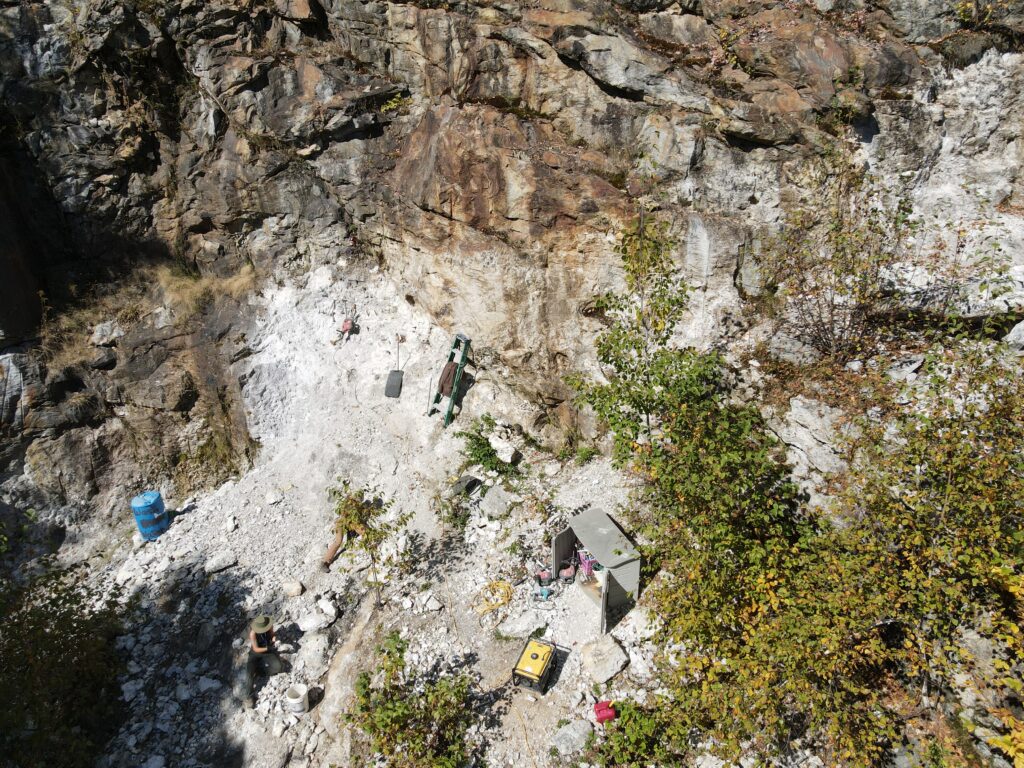
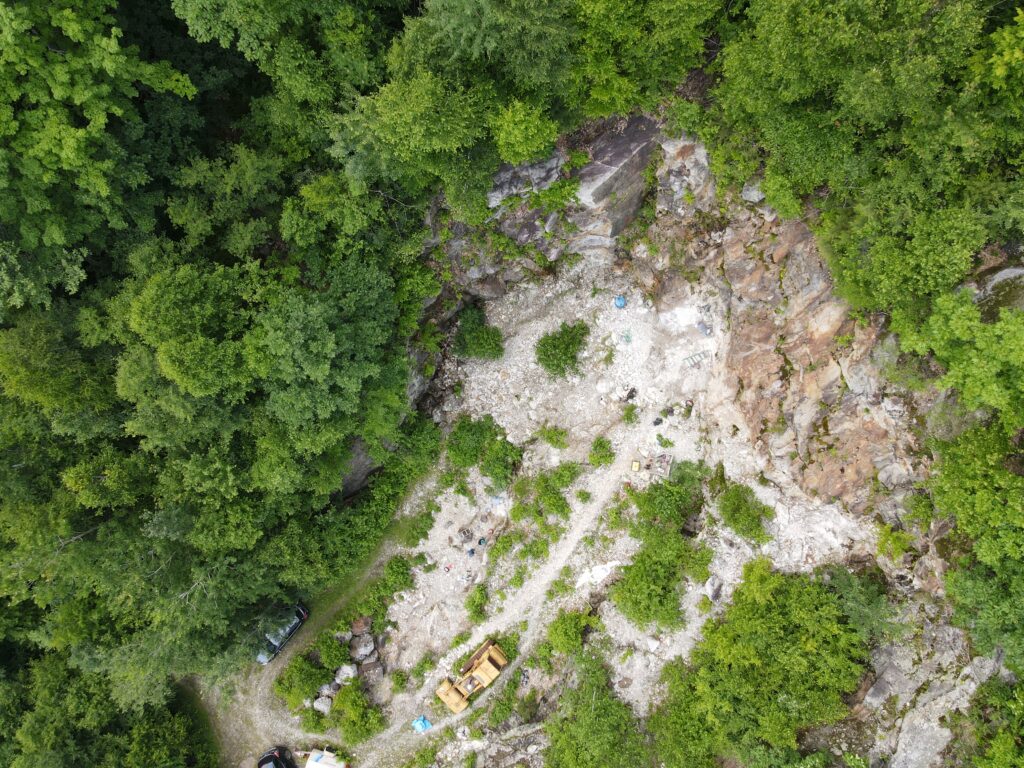
The Emmons pegmatite (Fig. 3) is an example of a highly evolved boron-lithium-cesium-tantalum-enriched pegmatite (Falster et al. 2019, Simmons et al. 2012).

FIGURE 3a– Quarry/pegmatite exposure- field image
FIGURE 3b– Quarry/pegmatite exposure- field image

Internal Zonation

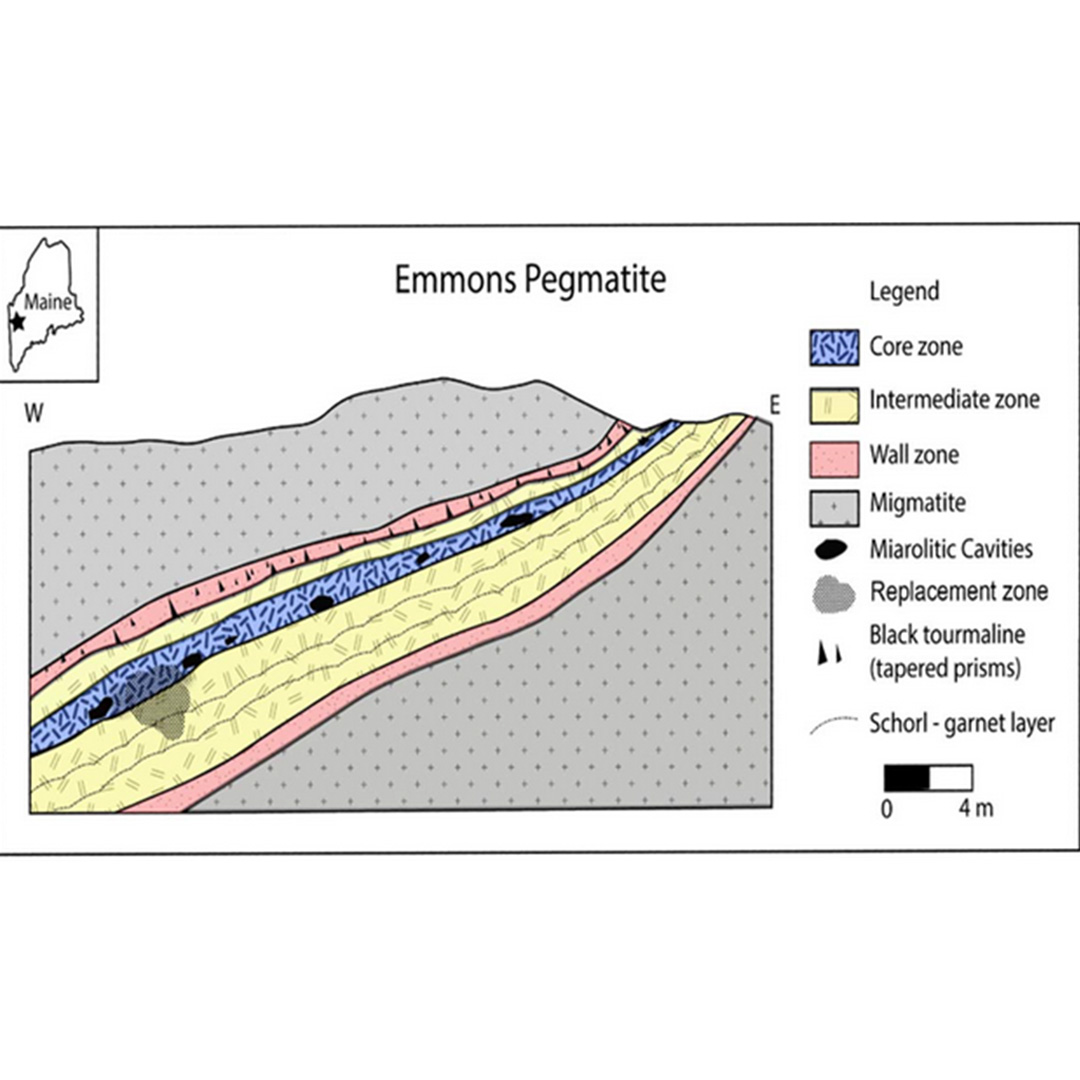
The complexly zoned Emmons pegmatite (Fig. 4) extends over an area of approximately 120 × 18 m within migmatitic country rock (calc-silicate and biotite schist).

FIGURE 4– Zoning pattern in the emmons pegmatite. Modified from Serrano et al. (2017) by S.L. Hanson. Elbaite/fluor-elbaite occurs in miarolitic cavities in the core zone as well as in miarolotic cavities just above the schorl-garnet lines

However, based on numerous small outcrops exposed at distances extending 200 m from the main pit, the pegmatite is likely considerably larger. 

The internal zones, replacement units, and other important aspects of the pegmatite are described in Table 1.

Table 1

Zone

Mineralogical and Textural Features

Wall zone

Quartz, microcline, albite, muscovite, schorl, garnet group species (almandine-rich). The schorl comb texture is missing and is replaced by skeletal muscovite in parts of the pegmatite.

Intermediate zone

Similar in mineralogy to the wall zone but rarer mineral species begin to appear. The hanging wall of the intermediate zone is frequently graphic but the graphic texture is generally not as pronounced as in some of the other pegmatites in the field. The footwall intermediate zone is generally blocky in texture with finer-grained feldspars in the part where the two schorl-garnet bands are. An unusual second pocket zone is sometimes seen directly above the schorl-garnet bands. The footwall intermediate zone is the most voluminous zone in the Emmons pegmatite.

Core margin

Many rare species may be found. Ball muscovite is typically present and associated with the evolved mineralogy. Less evolved core zones usually lack the ball muscovite bands.

Core Zone

Abundant massive quartz or quartz-rich areas. The quartz is not continuous but forms masses that alternate with blocky feldspar, muscovite and rare spodumene. Primary phosphate masses of lithiophilite–triphylite, montebrasite and their secondary minerals are found here. Pollucite and alkali-rich beryl can occur here. Miarolitic cavities occur in the core margin and core zone.

Albite replacement unit

Very rich in small miaroles that are commonly interlinked. A large mass is currently exposed in the footwall intermediate zone in pit 2, the lowest pit, but a smaller one can be seen on the uppermost quarry wall.

Phosphate pod alteration

Alteration of the primary phosphate pods (lithiophilite-triphylite, montebrasite) produces a wealth of mineral species (Simmons et al. 2022). In most cases,

montebrasite and lithiophilite-triphylite are closely associated which adds to the mineral complexity because Al is supplied which can give rise to Al-bearing phosphates. Rhodochrosite is commonly associated with lithiophilite.

Miarolitic cavity assemblage

Typically, miarolitic cavities are albite and muscovite-rich, with variable amounts of quartz and microcline. Accessory species can include fluorapatite, beryl,

bertrandite, beryllonite, hydroxylherderite, Nb-Ta oxide species, and etched spodumene.

Mineral Species Diversity

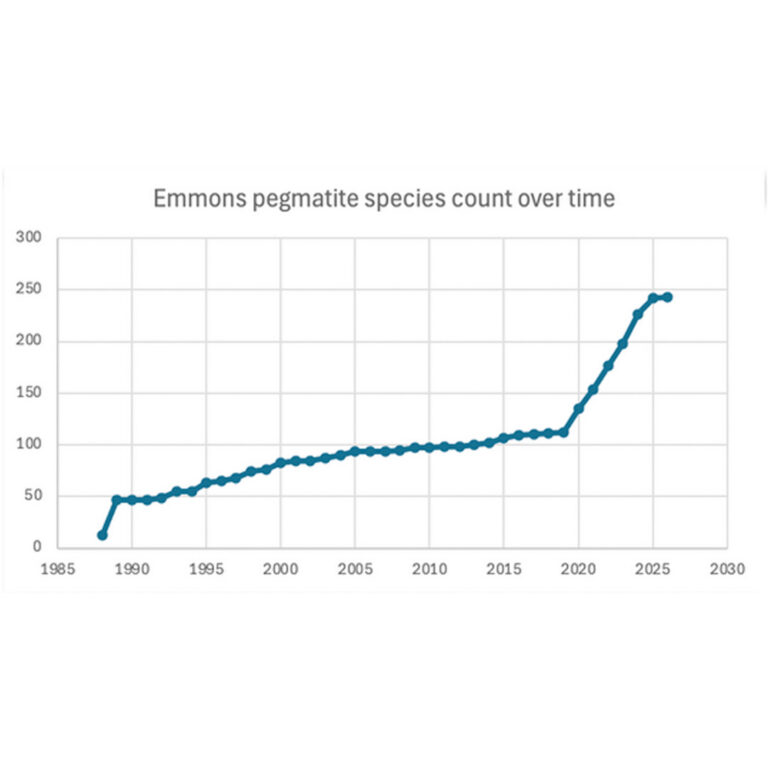
There are currently over 240 recognized mineral species at the Emmons pegmatite, making it the most species-rich pegmatite in Maine, Fig. 5.

FIGURE 5– Species count growth over time
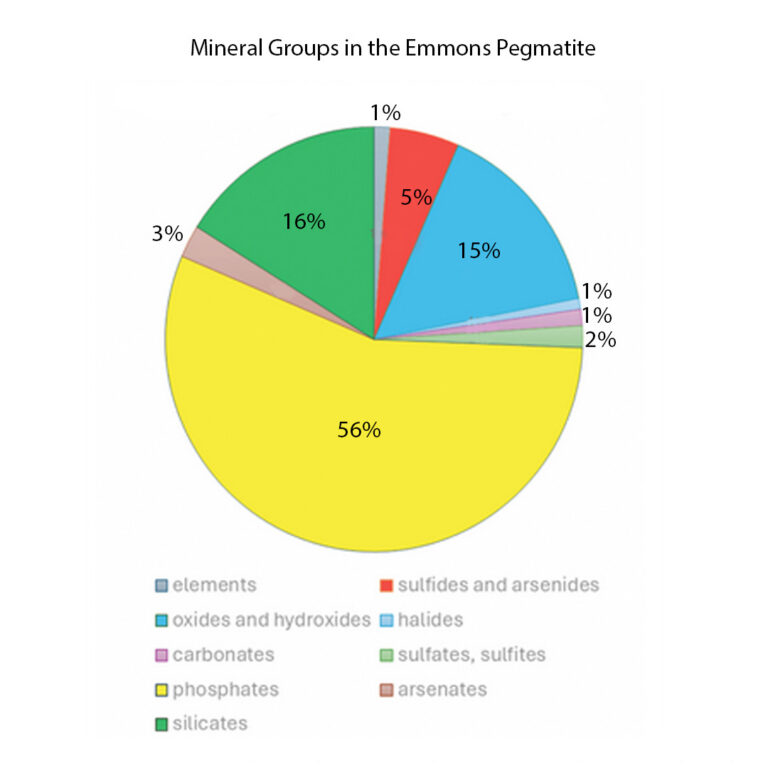
FIGURE 6– Pie chart showing relative mineral group abundances
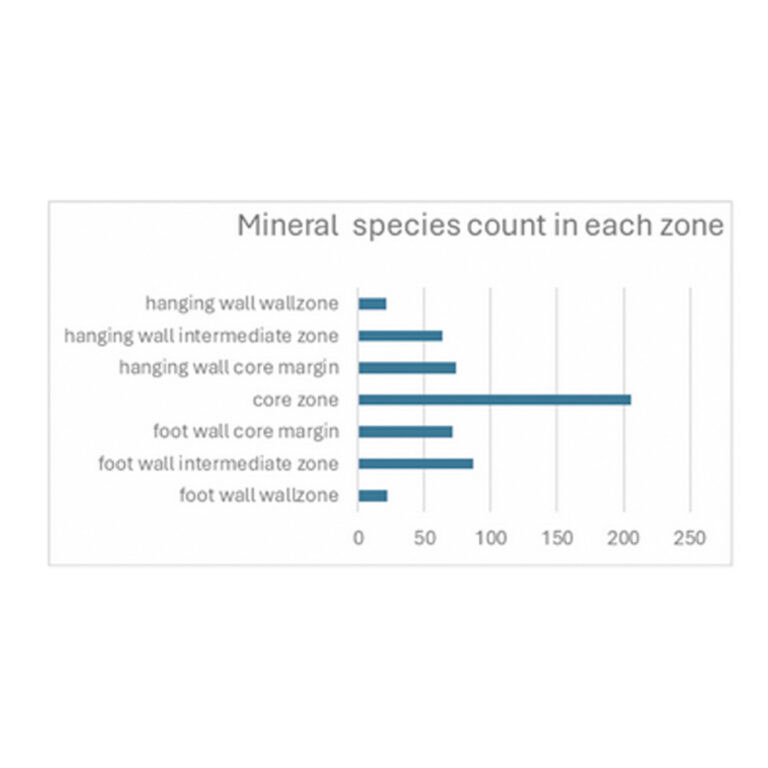
FIGURE 7- Relative mineral species count in each zone of the Emmons pegmatite.

Microenvironments and Mineral Formation

Full List of Documented Microenvironments at the Emmons Pegmatite

Distinct microenvironments within the pegmatite formed under localized chemical conditions (pH, Eh, and fluid composition), producing specific mineral assemblages. These environments act as small-scale chemical systems within the pegmatite.

Albite Replacement Microenvironments

Small miarolitic cavities within the albite replacement zone host albite, quartz, and muscovite, with accessory bertrandite formed from the breakdown of beryl. Additional accessory phases include fluorapatite, cassiterite, columbite-tantalite, perhamite, goyazite, and zircon.

Phosphate Replacement Microenvironments

Replacement of primary lithiophilite–triphylite produces extensive assemblages of secondary phosphate minerals, commonly associated with rhodochrosite.

Oxidizing, Na-rich Phosphate Pod Microenvironments

Oxidizing conditions with sodium influx near phosphate pods produce Fe³⁺-dominant phosphate assemblages, including kapundaite, cyrilovite, sidorenkite, and meurigite-(Na). Where potassium is elevated, meurigite-(K) may also form.

Moderately Oxidizing Phosphate Microenvironments

Moderately oxidizing conditions near phosphate pods produce partially trivalent manganese phosphate assemblages, including robertsite, joosteite, and ercitite.

Strongly Oxidizing, Na-poor Phosphate Microenvironments

Strongly oxidizing conditions without sodium influx produce phosphate assemblages including cacoxenite, phosphosiderite, and strengite.

Multi-element Interaction Microenvironments (Li–Cs–Be)

Localized interaction between altering lithiophilite, beryl, and pollucite produces the rare Li–Cs–Be silicate pezzottaite.

Pollucite–Lepidolite Reaction Microenvironments

Lepidolite veins cutting pollucite produce analcime-rich cores, reflecting depletion of cesium and relative enrichment in sodium.

Beryl Alteration Microenvironments

Alteration of beryl produces secondary beryllium minerals including bertrandite, hydroxylherderite, moraesite, and behoite.

Sulfide–Clay Interaction Microenvironments

Interaction between corroding pyrrhotite and tosudite produces gravegliaite.

Beryllonite Alteration Microenvironments

Alteration of beryllonite produces hydroxylherderite, fluorapatite, carbonate-rich apatite, and moraesite.

Cesium-Beryl Assemblage Microenvironments

Cesium-rich beryl occurs in association with green muscovite and accessory väyrynenite and viitaniemiite.

Sulfide-Influenced Phosphate Microenvironments

Alteration of lithiophilite in proximity to sulfides produces diadochite.

Reducing Phosphate Microenvironments

Non-oxidizing conditions near altering lithiophilite produce reduced phosphate assemblages, including vivianite, phosphoferrite, reddingite, fairfieldite, childrenite–eosphorite, switzerite, hureaulite, and dickinsonite.

Oxidizing Phosphate Microenvironments

Oxidizing conditions produce Fe³⁺-dominant phosphate assemblages, including strunzite, rockbridgeite, jahnsite-group minerals, laueite/pseudolaueite, stewartite, bermanite, earlshannonite, beraunite, and mitridatite.

Beryl Dissolution Microenvironments

Partial or complete dissolution of beryl produces assemblages including fluorapatite, bertrandite, cookeite, and locally hydroxylherderite.

Pollucite Replacement Microenvironments

Replacement of pollucite (and possibly petalite) produces assemblages including muscovite, albite, quartz, cookeite, lepidolite, fluorapatite, goyazite, and brazilianite.

Fluorine-rich Montebrasite Alteration Microenvironments

High fluorine activity during montebrasite alteration produces carlhintzeite, kiryuite, and gunmaite.

Montebrasite–Lithiophilite Interaction Microenvironments

Alteration of montebrasite in proximity to lithiophilite produces diverse phosphate assemblages, including lacroixite, berlinite, wavellite, burangaite, bertossaite, rosemaryite, wardite, wyllieite, and whiteite-group minerals.

Schorl Replacement Microenvironments

Replacement of schorl produces assemblages of muscovite and lepidolite, siderite-rich carbonates (often altered to goethite and hematite), late-stage rossmanite overgrowths, and rare anatase.

Arsenide Oxidation Microenvironments

Oxidation of löllingite or arsenopyrite produces scorodite, arseniosiderite, and native arsenic.

REFRENCES

BRADLEY, D.C., TUCKER, R.D., LUX, D., HARRIS, A.G., & MCGREGOR, D.C. (2000) Migration of the Acadian Orogen and Foreland Basin Across the Northern Appalachians. United States Geological Survey Professional Paper 1615 (49 pg.). United States Geological Survey, United States Department of the Interior, Reston, Virginia, USA.

BRADLEY, D.C., SHEA, E., BUCHWALDT, R., BOWRING, S., BENOWITZ, J., O’SULLIVAN, P., & MCCAULEY, A. (2016) Geochronology and tectonic context of lithium-cesium-tantalum pegmatites in the Appalachians. The Canadian Mineralogist 54, 1–25. DOI: https://doi.org/10.3749/canmin.1600035 

EUSDEN, J.D., BAKER, S., CARGILL, J., DIVAN, E., HILLENBRAND, I., O’SULLIVAN, P., & WHEATCROFT, A. (2017) Transect from the migmatized Central Maine Belt to the Bronson Hill Anticlinorium. In Guidebook for Field Trips in Western Maine and Northern New Hampshire, New England Intercollegiate Geological Conference 109th Annual Meeting (B. Johnson and J.D. Eusden, eds.).

KING, V.T. & FOORD, E.E. (1994) Mineralogy of Maine. Vol. 1: Descriptive Mineralogy. Maine Geological Survey, Augusta, Maine, USA.

RAND, J.R., JR. (1957) Maine Pegmatite Mines and Prospects and Associated Minerals. Minerals Resources Index 3, 1–43. Maine Geological Survey, Augusta, Maine, USA.

ROBINSON, P., TUCKER, R.D., BRADLEY, D.C., BERRY, H.N., IV, & OSBERG, P.H. (1998) Paleozoic orogens in New England, U.S.A. GFF 120, 119–148.

SIMMONS, W.B., WEBBER, K.L., FALSTER, A.U., RODA-ROBLES, E., & DALLAIRE, D.A. (2022) Pegmatology: Pegmatite Mineralogy, Petrology and Petrogenesis. Rubellite Press, Cana, Virginia, USA, 292 pp.

SERRANO, J.G., RODA-ROBLES, E., VILLASECA, C., & SIMMONS, W.B. (2017) Fe-Mn-Mg distribution in primary phosphates and silicates, and implications for the internal evolution of the Emmons rare element pegmatite Maine, USA. In Peg 2017: 8th International Symposium on Granitic Pegmatites: Abstracts and proceedings of the Geological Survey of Norway, Kristiansand, Norway (37–40).

SIMMONS, W.B., PEZZOTTA, F., SHIGLEY, J.E., & BEURLEN, H. (2012) Granitic pegmatites as sources of colored gemstones. Elements 8, 281–287.

SOLAR, G.S. & BROWN, M. (2001) Petrogenesis of migmatitesin Maine, USA: Possible source of peraluminous leucogranite in plutons? Journal of Petrology 42(4), 789–823. DOI: https://doi.org/10.1093/petrology/42.4.789 SOLAR, G.S. & TOMASCAK, P.B. (2009) The Sebago Pluton and the Sebago Migmatite Domain, southern Maine; results from new studies. In 2009 Annual Meeting of Northeastern Section, Geological Society of America Field Trip 2, 1–24.

SOLAR, G.S. & TOMASCAK, P.B. (2016) The migmatite-granite complex of southern Maine: Its structure, petrology, geochemistry, geochronology, and relation to the Sebago Pluton. In Guidebook for Field Trips Along the Maine Coast from Maquoit Bay to Muscongus Bay (H.N. Berry IV and D.P. West Jr., eds.). New England Intercollegiate Geological Conference, October 14–16, Concord, New Hampshire (19–42).

WEBBER, K.L., SIMMONS, W.B., & FALSTER, A.U. (2018) Petrogenetic model for the formation of the anatectic Oxford Co., Maine, USA pegmatite field. In International Mineralogical Association 2018 abstract volume 291.

WEBBER, K.L., SIMMONS, W.B., FALSTER, A.U., & HANSON, S.L. (2020) Anatectic pegmatites of the Oxford County pegmatite field, Maine, USA. The Canadian Mineralogist 57, 811–815.

WISE, M.A. & BROWN, C.D. (2010) Mineral chemistry, petrology and geochemistry of the Sebago granite pegmatite system, southern Maine, USA. Journal of Geoscience 55, 3–26.
Join Our Newsletter

Discover the magic of minerals and gems! Subscribe to our newsletter below.