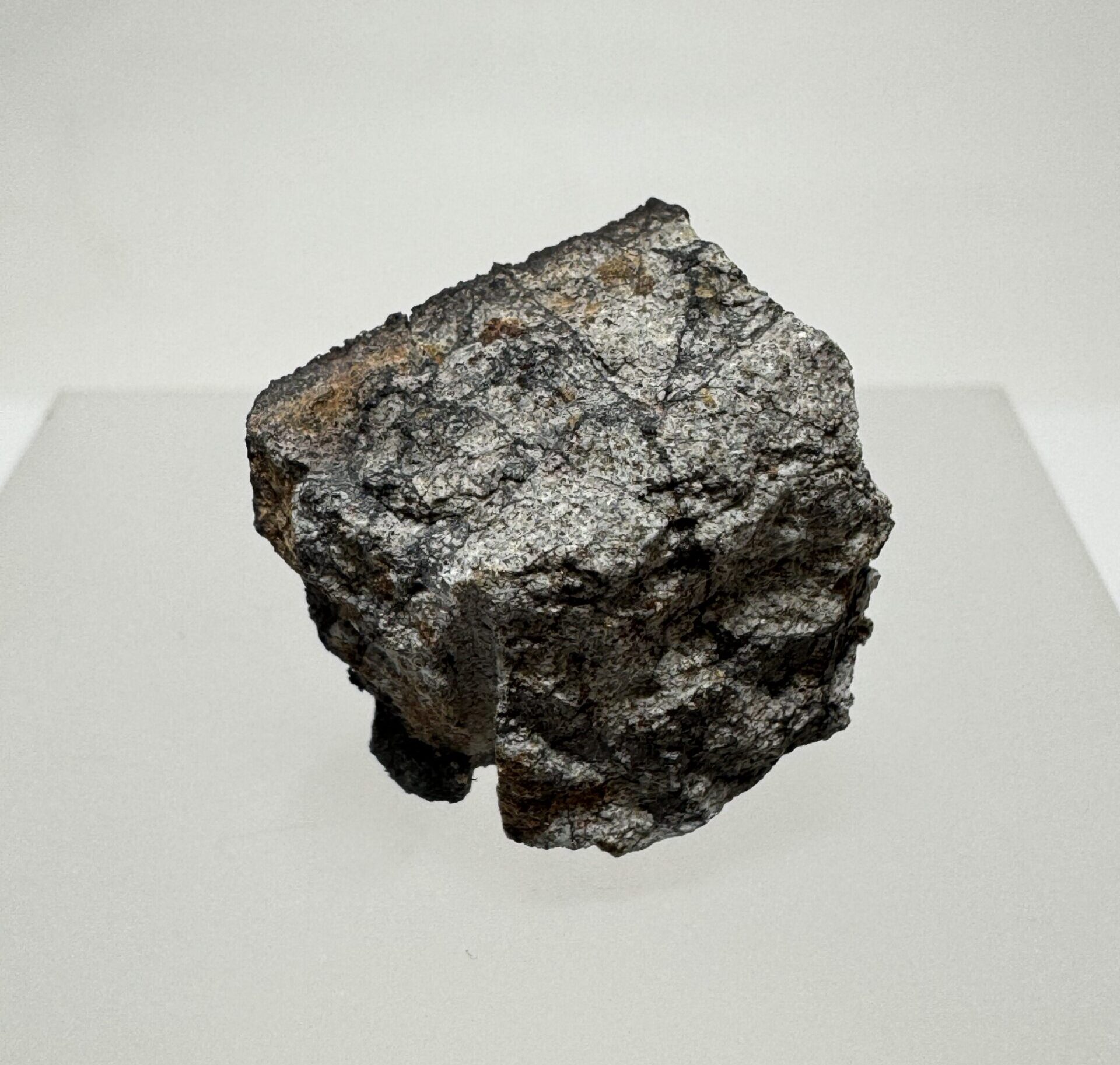
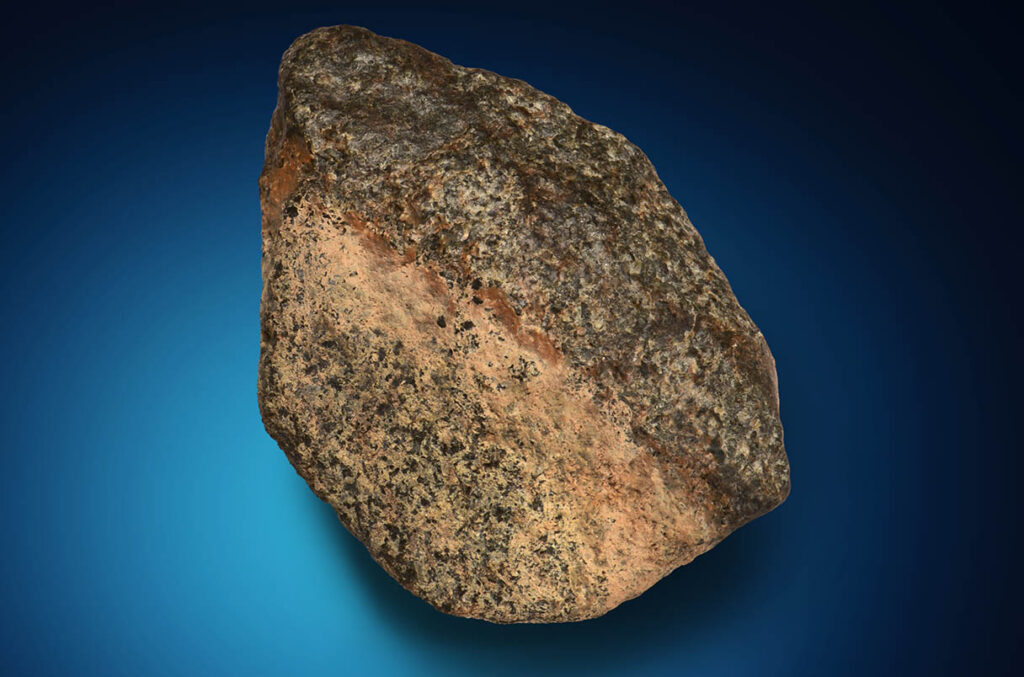
Teghaza 001 may be the oldest identified meteorite from Mars, preserving evidence of the planet’s ancient crust and the early loss of its water. MMGM owns the main mass of the meteorite and most of its known pieces, helping make this rare material available for scientific research.
The Maine Mineral & Gem Museum (MMGM) is home to Teghaza 001, a rare Martian meteorite that is giving scientists a new look at Mars more than 4.1 billion years ago. Discovered in the Sahara Desert by Sahrawi prospectors, the meteorite may be the oldest identified rock from Mars and is only the second known Martian meteorite to preserve a record of the planet’s earliest crust.
The findings, reported in Science, highlight the importance of this unusual specimen and the role museum collections can play in advancing scientific research. MMGM owns the meteorite’s main mass and holds most of its known pieces, including material made available to researchers studying the early history of Mars.
Teghaza 001 is already challenging some long-held ideas about the Red Planet. Unlike most known Martian meteorites, which are dark volcanic rocks called basalts, Teghaza is unusually rich in silicon. Its composition suggests that ancient Mars may have developed a more chemically diverse crust than scientists once expected, including rocks with some similarities to granite.
The meteorite also preserves evidence of Mars’s early relationship with water. By examining the proportions of hydrogen and its heavier isotope, deuterium, researchers have found signs that the planet was losing water billions of years ago. The results suggest that this process was underway more than 4.1 billion years ago, offering a glimpse of Mars during a period when its surface and atmosphere were very different from what we see today.
Teghaza 001 contains abundant zircon crystals, which allow scientists to estimate the age of ancient rocks. These minerals help researchers reconstruct events that took place early in the history of the solar system, long before life emerged on Earth. Further study of the meteorite may reveal more about the formation of the Martian crust, the role of water in shaping the planet, and the conditions that existed on rocky planets in the solar system’s early years.
Until now, the 4.1-billion-year-old Allan Hills 84001 meteorite, discovered in Antarctica in 1984, was the only other known Martian meteorite to preserve crust from this earliest period of the planet’s history. Having a second specimen to study gives researchers another opportunity to investigate ancient Mars and compare evidence preserved in rocks formed billions of years ago.
For MMGM, Teghaza-001 is part of a broader collection that is helping scientists answer fundamental questions about our solar system. The museum holds one of the world’s most significant collections of lunar and Martian meteorites, including material that provides direct evidence of the geological histories of the Moon and Mars. These specimens are more than rare objects: they are research materials that can contribute to new discoveries about planetary formation, the evolution of rocky worlds, and the conditions that may be necessary for life.
As research continues, Teghaza 001 is expected to offer further insights into Mars’s ancient environment. Its unusual composition and evidence of early water loss make it a particularly valuable specimen, and its presence in the MMGM collection connects a remarkable discovery in the Sahara to ongoing scientific work around the world.
You can learn more about this meteorite form the article linked below: https://www.science.org/content/article/oldest-known-mars-rock-offers-glimpse-planet-s-watery-youth
About the Maine Mineral & Gem Museum
Nestled in the heart of Bethel, Maine, the Maine Mineral & Gem Museum is home to the most significant collection of Maine minerals and gemstones in the world. The museum also houses an internationally significant collection of meteorites, including rare specimens from the Moon and Mars that contribute to ongoing research into the history and evolution of the solar system. Through its collections, exhibits, education programs, and support for scientific research, MMGM invites visitors to explore the remarkable story of our planet and its place in the universe.
For admission information and upcoming events, visit www.mainemineralmuseum.org and follow MMGM on Facebook and Instagram @mainemineralmuseum.
For more information, contact MMGM media contact Aidan McCourt at amccourt@mainemineralmuseum.org.